
WHAT’S ACTUALLY IN THE BOTTLE?
In "Last Call for Accountability," we looked at what it takes to legally pour a drink — certifications, licensing, protections built around bartenders and the product itself. Much of that traces back to proof level: alcohol content determines tax classification, so someone is required to verify what's in the bottle. The safety testing is partly a byproduct of the government wanting its cut.
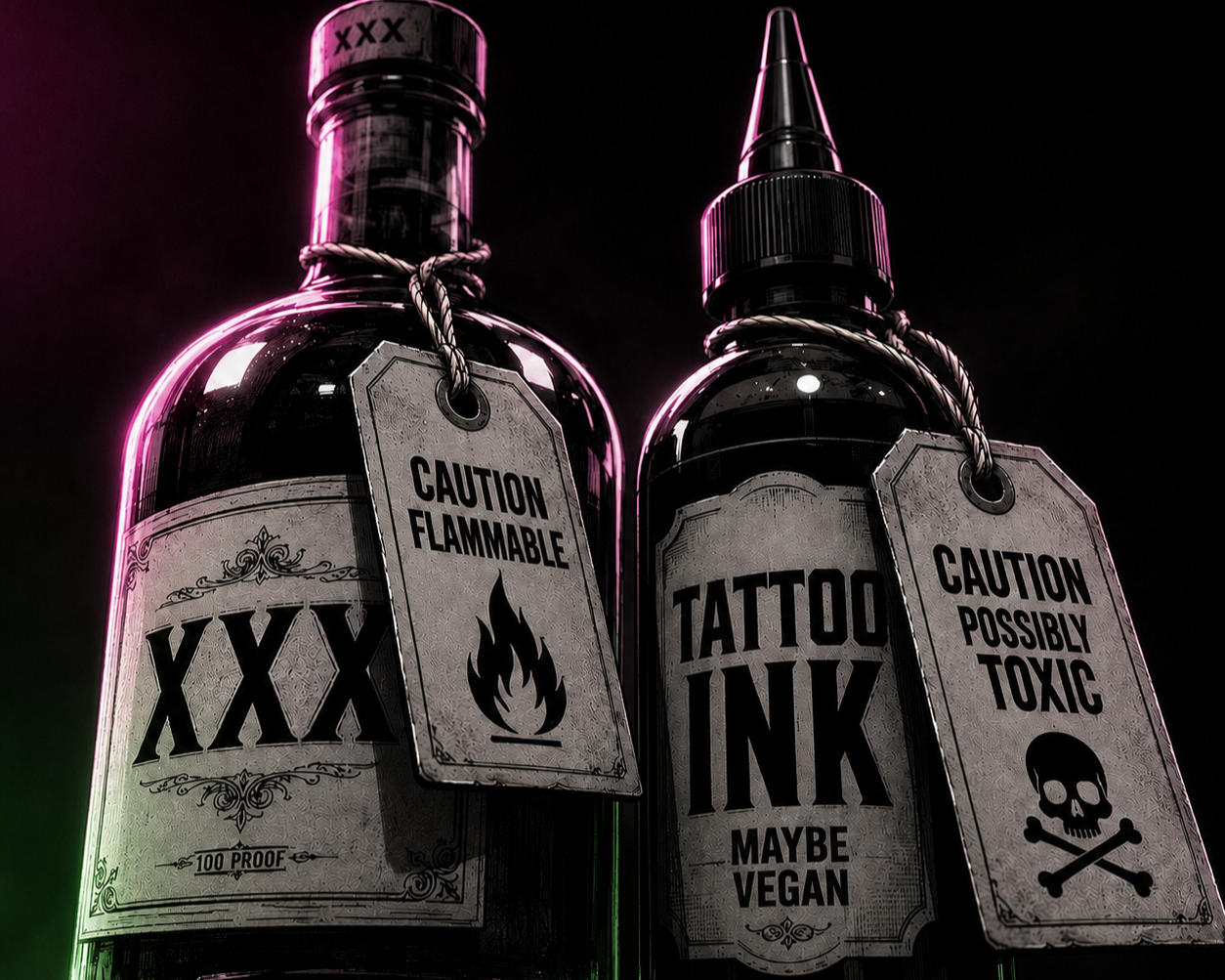
Tattooing has no equivalent incentive — no proof level, no tax bracket tied to ink composition, no structural reason for anyone to verify what's inside. A glass of wine passes through your system in about 8 hours, tested the whole way. Tattoo ink stays under your skin permanently, and nobody's checking what's in it.
Ask almost any tattoo artist whether their ink is vegan, sterile, or "clean," and you'll get a confident answer. Ask how they know, and the confidence thins fast. It's one of the most common questions at the counter these days — powder pigment or acrylic-based carrier, gamma-sterilized or not, plant-derived or animal-adjacent. Artists want to answer honestly. The problem isn't that nobody's asking. It's that almost nobody outside the manufacturer is checking.
Pigment…
Raw powder pigments are the older standard, but most modern inks arrive pre-dispersed in a carrier solution, often acrylic-based, keeping the pigment stable and spreadable. That carrier does quiet, important work — viscosity, how the ink lays into skin, how it heals. But the formulation is rarely disclosed with any specificity. "Proprietary blend" shows up more often than an actual ingredient list.
Sterilization.
Most manufacturers rely on gamma radiation — a legitimate, widely used method. The issue isn't the method. It's that "sterilized" on a label is a claim, not a certification artists can independently verify. There's no routine third-party testing confirming every batch was processed as stated.
There's a second layer that gets even less attention. Glycerin, or glycerol, shows up in a striking number of inks on the market — and gamma radiation applied to glycerin-containing solutions can produce formaldehyde as a byproduct. That's not a fringe finding; it's a known interaction. What's missing is anyone tracking whether it's happening in tattoo ink specifically, at what levels, or what it means to have that byproduct sitting under skin permanently rather than passing through the body once.
"Vegan."
More ink brands market themselves this way, and clients increasingly ask for it by name. But "vegan" in this industry is almost entirely self-reported. There's no regulatory body auditing formulations for animal-derived ingredients, no third-party certification verified against the supply chain. A brand can call itself vegan because it believes it, because a supplier said so, or because it tests well with a values-driven customer.

Put those pieces together and a pattern shows up: pigment composition, sterilization, and ethical sourcing all rest largely on manufacturer word. In the U.S., tattoo ink falls into a regulatory gap — the FDA technically has authority over pigments as cosmetic color additives, but enforcement has historically been thin and reactive, usually triggered only after adverse event reports pile up. There's no pre-market approval process like a pharmaceutical might face.
That gap doesn't mean anyone's lying. Most manufacturers are likely producing what they claim. But "likely" is doing a lot of work in an industry that's permanent, under someone's skin. Without independent verification, the whole system runs on trust — artist trusts distributor, distributor trusts manufacturer, client trusts artist — with no outside check on any link.
Transparency isn't a marketing angle here — it's the foundation the industry needs to keep growing into the mainstream space it's earned. Tattooing has spent 20 years shedding stigma and being taken seriously. That credibility doesn't survive on reputation alone; it survives on artists answering client questions honestly, with real information instead of manufacturer copy repeated as fact.
An industry serving all clients — sensitive skin, ethical commitments, the ones simply asking "is this safe" — has to back up its claims with something more solid than a label. Pushing for clearer ingredient disclosure, third-party sterilization verification, and real vegan certification isn't about distrust of manufacturers. It's about giving artists the tools to earn the trust their clients are already extending. Until the industry has a way to independently verify what's coming out of the bottle, every honest answer at the counter is still, in part, a guess.
