
Placement Is the Punchline
Most conversations about tattoo placement end at the practical: Will it fade in the sun? Will it stretch with weight change? Will it show up at work? Those questions matter, but they treat placement as a liability to manage rather than a design element to exploit. The body isn't just a canvas — it's a mechanism. It bends, folds, flexes, and moves in ways that flat paper never will. And most tattoos ignore that completely.
Look at a simple skull-and-crescent design tattooed sideways along the length of a finger. Viewed straight on, it reads as an abstract sliver of shading inside an oval. Bend the finger, and the whole thing resolves into a grinning skull, the joint crease becomes the punchline. That's not a tattoo placed on a finger. That's a tattoo built for a finger, one that needs the anatomy to complete itself.
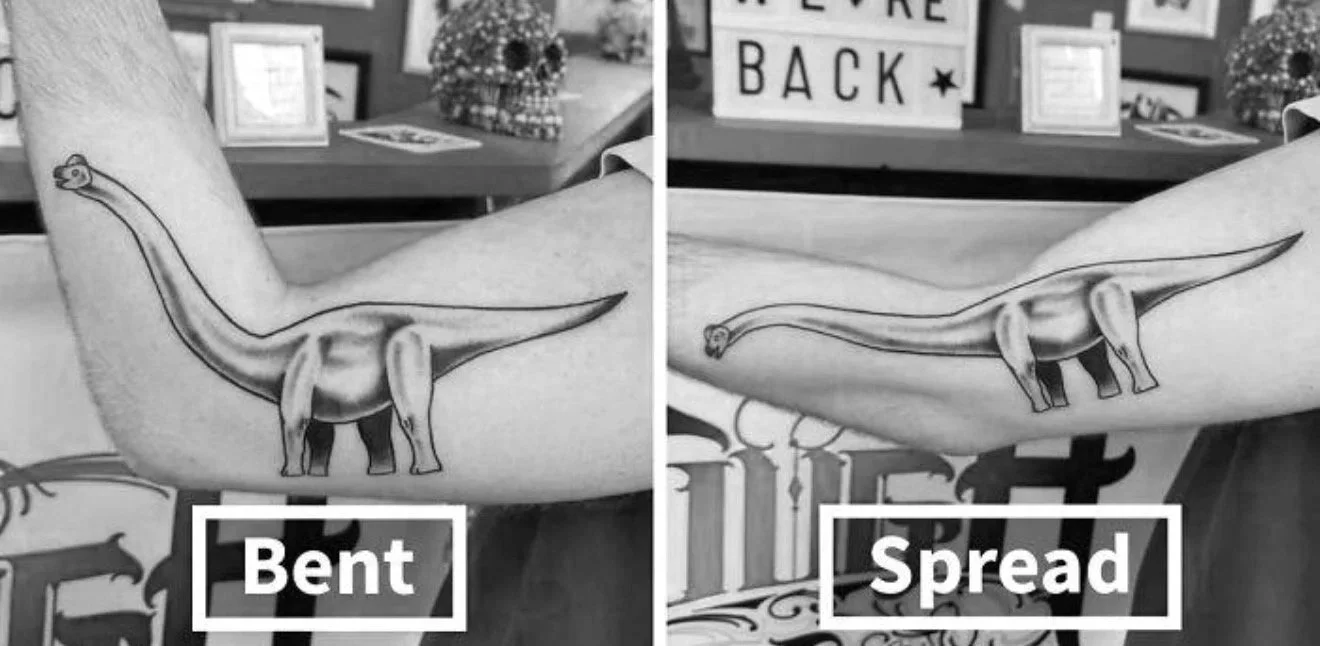
The same logic shows up in a full brachiosaurus laid across an inner elbow. Arm bent, the dinosaur compresses into a short, squat little guy. Arm extended, its neck stretches out to full, absurd length. The tattoo has two states, and neither one is the "real" version — the joke is the transformation itself, something no static flash sheet design could ever deliver.
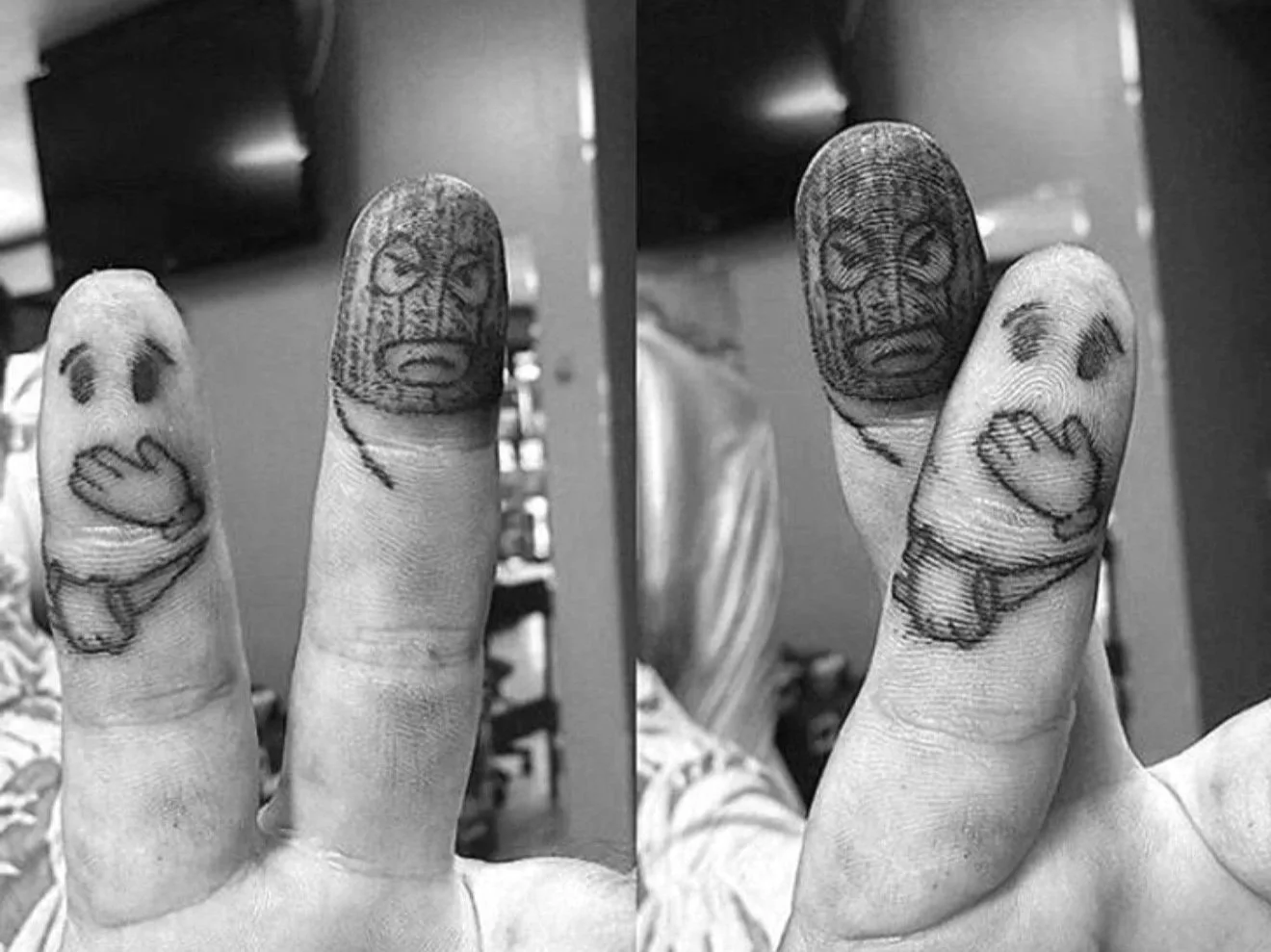
Then there's the two-finger bit: a worried little cartoon face on the index finger, a scowling stone mask on the thumb, positioned so that pressing the fingers together turns it into a tiny confrontation, a two-character scene the wearer can perform on command. It's a tattoo that requires a gesture to exist as a narrative at all.
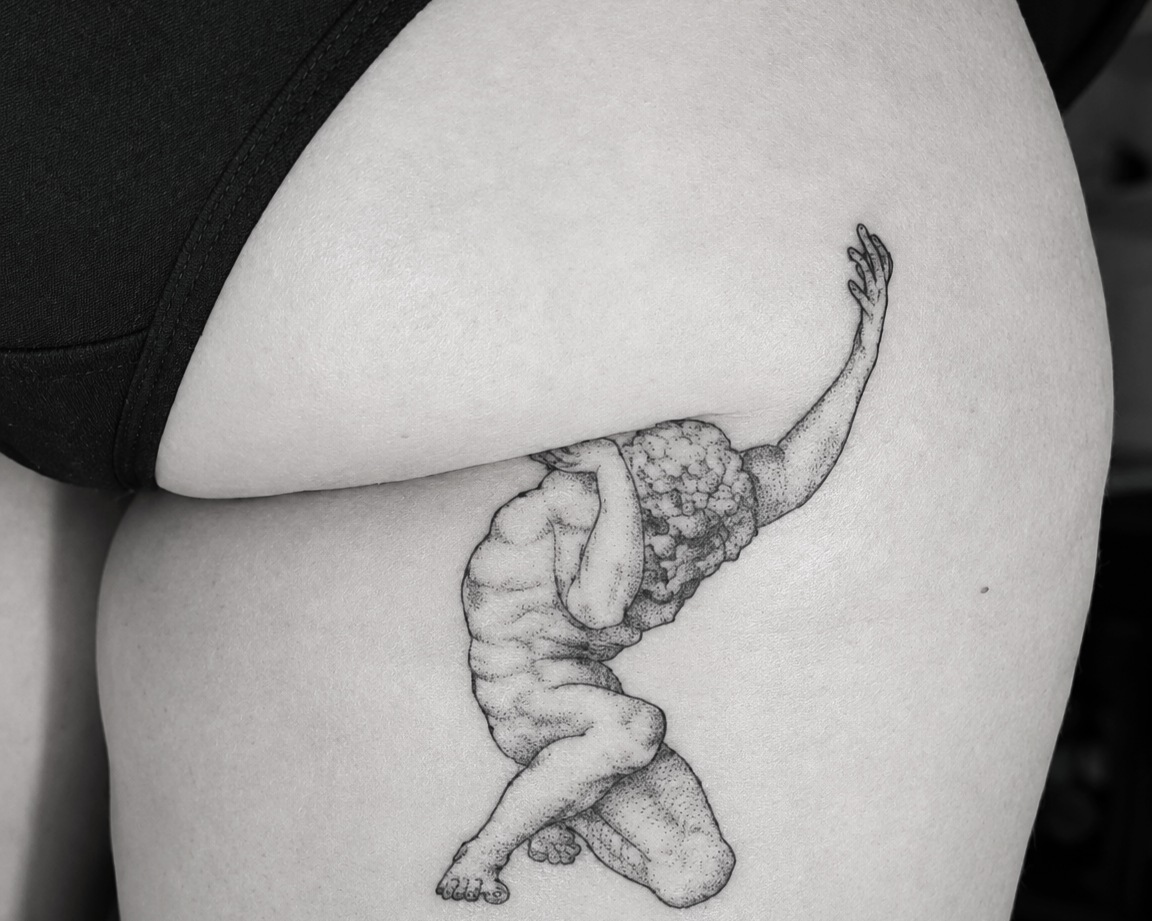
And on the more cheeky end, there's the classic sense-of-humor placement: a finely rendered Atlas straining under an invisible weight, inked right where the glute crease does the work of "the heavens" pressing down. The wearer said it plainly — no deep meaning, just a bit that gets better with age and gravity. That's placement as a built-in joke with a self-updating punchline.
None of these are technically difficult tattoos. What makes them work is that the artist thought about the body as an active surface rather than a passive one. They asked: what does this joint do, what does this crease do, what does this fold do — and how can the art use that instead of fighting it?
Most placement decisions in the industry are still driven by visibility and symmetry. Fair enough for a lot of clients. But there's a whole category of design language sitting mostly untouched: tattoos that are only finished when the body moves.
Give the canvas a job, not just a spot.
