
INSIDE THE INDUSTRY: STENCIL EVOLUTION
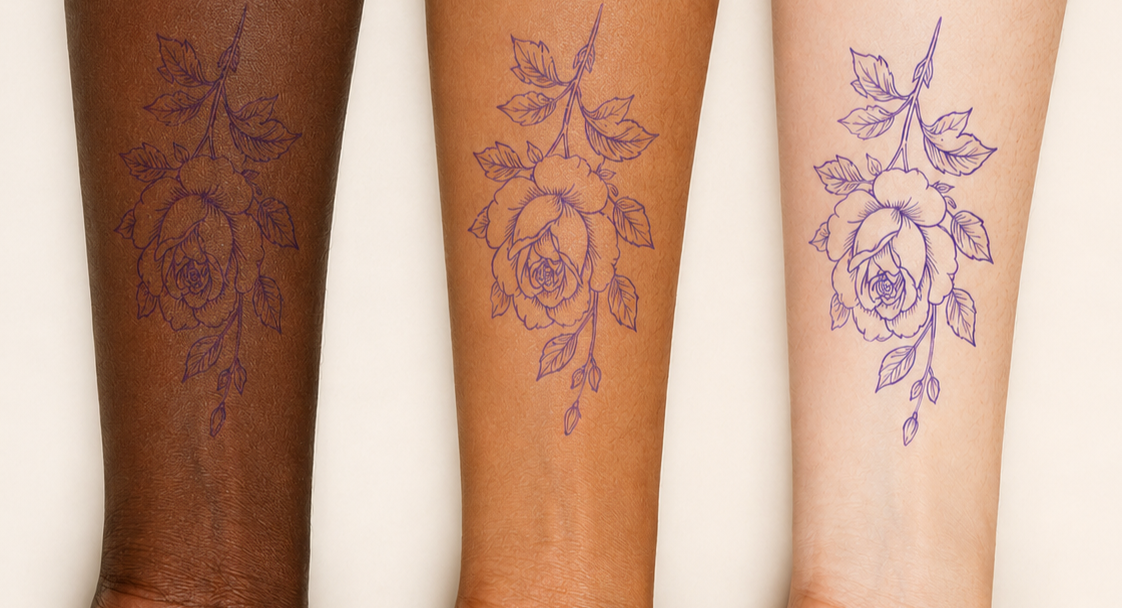
There's a moment before every tattoo starts that clients barely register — the artist presses a purple-inked sheet against skin, peels it back, and there's the blueprint. It feels incidental, but that blueprint has its own history: artists solving the same problem with whatever tools their era gave them. Almost none of those tools were built with darker skin tones in mind, and that blind spot has quietly followed every version since. That problem, in more ways than one, is being solved again.
Before anyone printed a stencil, artists etched designs into acetate or celluloid, sometimes for hours. Then came hectographic pencils in the 1870s, and later carbon paper — faster, but still manual.
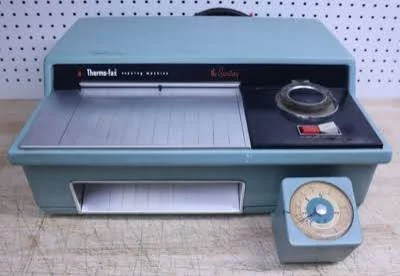
The real leap came in the 1970s, almost by accident. Tattooists raided office supply closets for 3M Thermo-Fax machines and found heat-transferred carbon made cleaner, more consistent stencils than hand-tracing. Lou Robbins gets credit for spotting it first. When 3M stopped making the machines, a paper manufacturer built a version for tattooing, and thermal transfer became standard almost overnight. Digital design finished the job: once artists drew on iPads, thermal printers gave a direct line from screen to skin.
Each shift took time and uncertainty out of the part before the needle touches skin, so the artist could spend more of the session on the part that matters. That's the lineage the newest tool is stepping into.
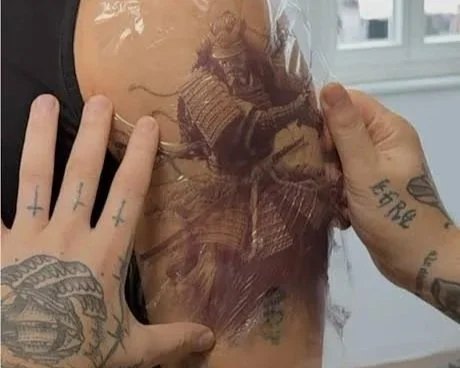
The most visible product here is STANDSTILL, a German-made transfer film of medical-grade polyvinyl alcohol (PVA). Where thermal paper is single-use and unforgiving the moment it shifts, STANDSTILL is transparent, stretchable, repositionable, and designed to be tattooed straight through. Artists print the design onto the film, apply it with a latex-free adhesive spray, then mist it with disinfectant until it turns matte — the cue it's ready to work through. The needle breaks the film down locally as it passes.
Artists report real gains: a misplaced stencil lifts and reapplies without residue, useful for cover-ups where clients need to see a design against existing ink before committing; detail holds up on elbows and other tricky curves that make paper shift or smear; removal is clean, no purple stain. The current limit: it's built for linework and dotwork, not heavy shading.
Every prior leap in this lineage solved for speed and consistency in getting a design onto skin. This is the first to solve something thermal paper structurally can't: staying accurate through the act of tattooing itself, not just until the first needle pass smudges it.
That has real downstream effects: cover-ups, historically hard to sell because the client is trusting an idea rather than seeing it, get a genuine visual bridge. Complex placement gets less dependent on an artist fighting a stencil that won't cooperate with a joint. Apprentices, whose early mistakes have always cost client trust, get a more forgiving material to learn on.
None of that guarantees an industry-wide shift — thermal transfer took years to become default. This film sits where thermal transfer did in the mid-1970s: promising, early-adopted, not yet standard.
"Medical-grade" gets thrown around loosely in this industry, so it's worth being precise. PVA has a long, well-documented safety record in medicine — eye drops, wound dressings, dissolvable sutures — and polymer literature consistently describes it as biocompatible and non-irritating.
What's less solid: the claim that tattooing through the film is safe comes from the manufacturer, who says the process was evaluated during patenting — not the same as an independent, peer-reviewed study on this specific practice, and none currently appears to exist. More notably, the patent claim doesn't hold up to a paper trail check: STANDSTILL GmbH doesn't publish a patent number, filing jurisdiction, or the name of any evaluating third party, and a search across Google Patents, Espacenet, and USPTO databases found no matching filing. That's not proof of wrongdoing — pending EU applications can take 18 months to publish — but the "independently evaluated" claim currently rests on the company's word alone, with nothing external to check.
The more likely irritant, if any, is the adhesive spray rather than the PVA — worth flagging for clients with adhesive sensitivities. Standard tattoo allergic reactions, mostly linked to red pigment, remain a separate issue from the stencil method.
Every material in this lineage looked, at first, like it solved a small problem. None were pitched as reinventing tattooing — they just made the part before the needle a little more honest to the part after it. If this film holds up the way thermal transfer did, the industry won't announce the shift; it'll just stop reaching for purple paper. What it won't answer on its own is whether "patented" and "evaluated" mean what they're being asked to mean. That's not a materials question — it's a question of who's willing to show their work.
