
inside the industry : Needles
“A man paints with his brains and not with his hands.” — Attributed to Michelangelo
Whether painting on canvas or tattooing skin, the artist has always been the true source of the work. Skill, experience, and artistic vision will always matter more than the tool itself. Yet every form of art has evolved through innovation.
Painters progressed from natural pigments to manufactured paints. Brushes became more specialized. Airbrushes introduced entirely new techniques and styles. Today, digital illustration software, tablets, and emerging technologies continue to expand what artists can create. Every generation inherits better tools—but great art has never come from the tools alone.
In 1891, Samuel O’Reilly patented the first electric tattoo machine in New York City, forever changing the profession. His invention transformed tattooing from a hand-poked practice into a faster, more consistent process, illustrating how innovation can elevate craftsmanship without replacing the artist.
Tattoo machines continued to evolve. As rotary and pen-style machines became more widely adopted, they helped pave the way for interchangeable disposable cartridge systems. Handmade needle groupings gradually gave way to precision-manufactured cartridges that simplified setup, improved consistency, and supported modern sterile workflows. Together, these innovations reshaped how artists work, making tattooing more efficient while maintaining a focus on precision, safety, and the experience of both artist and client.
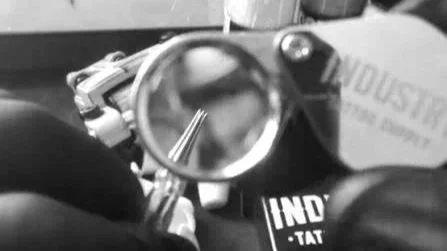
Today, these innovations are simply part of the craft. Artists spend years learning how different gauges, tapers, groupings, and needle configurations affect the final result. Every variation changes how ink is delivered into the skin, how clean a line heals, and how efficiently color is saturated. But while artists have become experts in how a needle performs, far fewer of us understand how that needle is actually made.
As tattooing evolved from handmade needles to precision-manufactured disposable cartridges, accountability evolved with it. Years ago, many artists built, inspected, and understood every detail of the needles they used. Today, much of that responsibility rests with manufacturers. Artists now place their trust in the engineering, materials, manufacturing processes, quality control, and sterilization methods used before a cartridge is ever opened.
That raises an important question:
What standards guide the manufacturing of the tools we rely on every day?
Engineering the Needle
Manufacturing a tattoo needle involves far more than sharpening a piece of steel.
Needle straightness, point geometry, taper consistency, grouping alignment, solder quality, and the absence of microscopic defects all influence how a needle performs. A bent needle, inconsistent taper, poor alignment, or manufacturing defect can affect precision, pigment delivery, and potentially increase unnecessary trauma to the skin.
Most tattoo needles are manufactured from stainless steel because of its strength, corrosion resistance, and ability to withstand sterilization. While higher-quality stainless steels generally provide greater durability and resistance to wear, there does not appear to be a publicly required stainless steel grade that every tattoo needle manufacturer must use.
Likewise, cartridge housings are commonly described as being made from medical-grade plastics, yet the exact polymers or resins are not always publicly disclosed. Some manufacturers identify materials such as medical-grade polycarbonate or ABS, while others simply reference proprietary medical-grade polymers without further explanation.
Greater transparency regarding material selection, manufacturing tolerances, quality-control practices, and validation testing would give artists a better understanding of the tools they trust every day.
Manufacturing and Sterilization
Every disposable tattoo needle must be sterilized before reaching the artist.
Most manufacturers use gamma irradiation or ethylene oxide, both well-established sterilization methods widely used for sterile medical products. However, sterilization is only one step in the manufacturing process.
In medical manufacturing, materials are typically evaluated to ensure they remain stable after sterilization. Some polymers can become brittle or otherwise change depending on the sterilization method used, making material selection an important engineering decision.
Publicly available information explaining how tattoo cartridge materials are selected, validated, and tested after sterilization is often limited. That does not suggest a problem exists—it simply highlights an opportunity for greater transparency regarding the engineering decisions behind these products.
The Textured Needle Debate
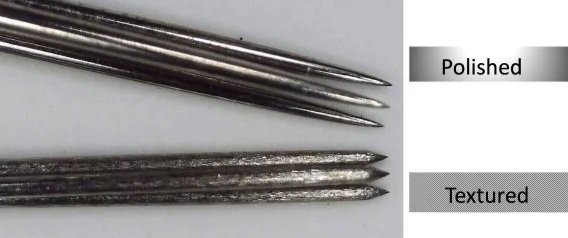
One of the industry’s most interesting innovations is the textured tattoo needle. Introduced during the 1990s by companies including Colonial Needle, John James Needles, and Unimax (which marketed its version as the Serpentine Needle), textured needles were designed with microscopic surface irregularities intended to retain more ink. Today, many premium cartridge manufacturers continue to market textured needles as providing improved ink flow or faster saturation.
The theory is certainly plausible.
However, to our knowledge, we have not identified independent, peer-reviewed studies demonstrating that textured tattoo needles improve ink delivery during human tattooing. Likewise, we have not identified published research evaluating whether textured needle surfaces influence the body’s biological response differently than polished needles.
That does not mean textured needles are ineffective—or harmful. It simply means many performance claims currently rely more on manufacturer information and artist experience than on independent scientific evidence. For an industry built on precision, that gap is worth exploring.
The purpose of asking these questions is not to criticize manufacturers or the artists who rely on their products. Tattooing has always progressed because people were willing to rethink the tools they used. Every major innovation—from the first electric tattoo machine to rotary and pen-style machines, disposable cartridges, and modern needle technology—has made the profession more consistent, more efficient, and safer.
Understanding how today’s needles are engineered is simply the next step in that tradition.
Asking thoughtful questions about manufacturing standards, material selection, engineering practices, quality control, testing, and transparency is not about finding fault. It is about encouraging the same curiosity that has driven tattooing forward for more than a century.
Every improvement begins with someone asking how a tool could become even better.
By continuing to ask those questions today, we create opportunities for stronger manufacturing practices, better research, greater transparency, and continued innovation tomorrow—not because the industry is failing, but because every great industry thrives by continuing to evolve.
