
Zoë Kravitz : CANVAS CURATION
Zoë Kravitz built one of the most recognized tattoo collections in pop culture, not through one sweeping design, but through more than 50 small, scattered pieces, a style now nicknamed the sticker sleeve, or sometimes the patchwork sleeve. Stars, dots, tiny words, and hand-poked charms accumulated across her arms over the years, less like a single tattoo and more like a personal scrapbook worn on the skin. Take the matching wrist charms tattoo artist Talia Migliaccio gave her in 2015, tiny stars, chevrons, and dots arranged into the shape of a cross on each wrist, done stick-and-poke style. It's the kind of piece easy to miss at a glance, and that's the point. This style is often read as less serious than a bold traditional sleeve, small ink dismissed as an afterthought rather than a statement.
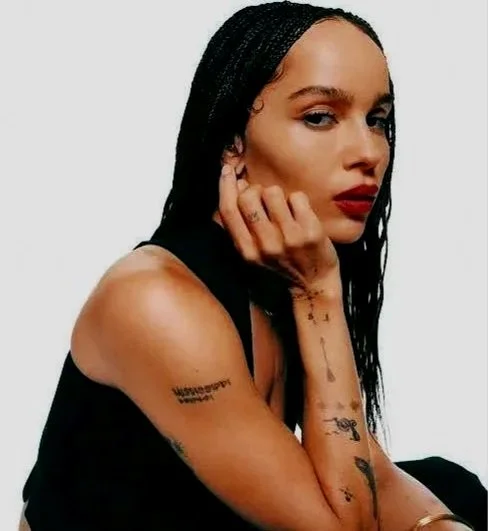
But Kravitz's next move complicates that assumption. She's on record calling tattoos "a beautiful form of adornment, just like makeup or jewelry." Think about how women often approach makeup as they age. The heavy layers of youth give way to something more pared back, not because there's less to offer, but because less is needed to feel confident.
Yet no other form of adornment works quite like a tattoo. No art collector displays their entire collection at once, all the time, in the same room, unless staging a themed show. A tattooed body does exactly that by default, every piece on view, permanently, whether it still fits together or not. Kravitz's hands alone tell that story, a hollow star outline on one middle finger, a hollow crown on the other, both permanent fixtures long before she started reconsidering any of them.
Animals do this differently. Chameleons rewrite their appearance in the moment. Cuttlefish take it even further, able to shift color and pattern across their skin almost instantly, a kind of real-time mimicry of emotion, fear, alertness, calm, all visible on the surface and just as quickly gone. It costs them nothing. There's no procedure, no permanence, just a living display that updates as fast as they feel it.
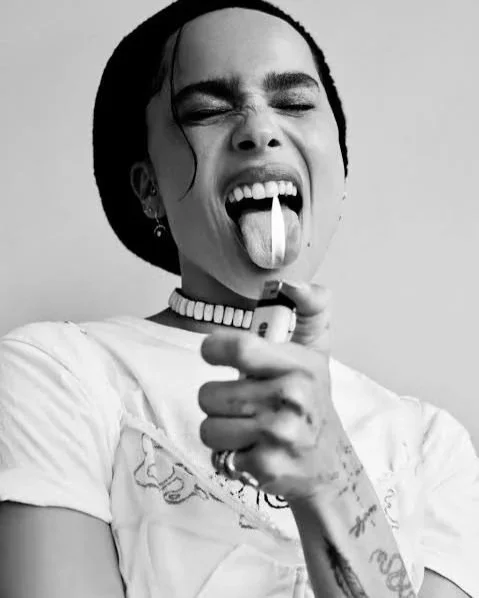
Humans who ink permanent adornment onto their skin don't get that reset button. A tattoo is not a purse you change out with the season, not a jewelry piece you unclasp, not a piercing that closes on its own. Once it's there, it stays, whether the person wearing it is nineteen or thirty-nine, whether the meaning behind it has grown, faded, or vanished.
That permanence is exactly what makes Kravitz's editing of her own collection worth paying attention to, no matter the size, no matter the scale, no matter how small the tattoos actually were. A tiny star on a middle finger carries the same weight of commitment as a full back piece. Size was never the measure of how serious a tattoo is, only how visible it happens to be. And it's not as if Kravitz collected these pieces carelessly. Several of her most detailed tattoos, an eagle, a snake wrapped around a heart, a second slithering snake on her other forearm, a palm tree marked "Bahamas," came from celebrity tattoo artist Dr. Woo, the same artist behind pieces on Hailey Bieber and Miley Cyrus. This wasn't impulsive collecting. It was curation.
After turning thirty, Kravitz began quietly removing several of those small pieces, including a middle-finger star she'd had since her teens. No scandal, no dramatic break from her past self. Her explanation was almost casual: she just didn't need it on her body anymore, part of moving past what she called "romanticizing the old is domestic thing." A woman who wears less makeup at forty than at twenty isn't erasing her younger self, she's decided she needs less to feel like herself. Kravitz's removals read the same way, not a rejection of who she was, but a recalibration of what she still wants on permanent display.
