
the ink healing hypothesis
In recent years, tattooing has entered a new kind of public conversation: not just as art or self-expression, but as a subject of immune science. Across social media, educational videos, and public discussions, people have explored how the immune system reacts when pigment is introduced beneath the skin—often focusing on inflammation, immune activation, and the body’s attempt to process a permanent foreign substance.
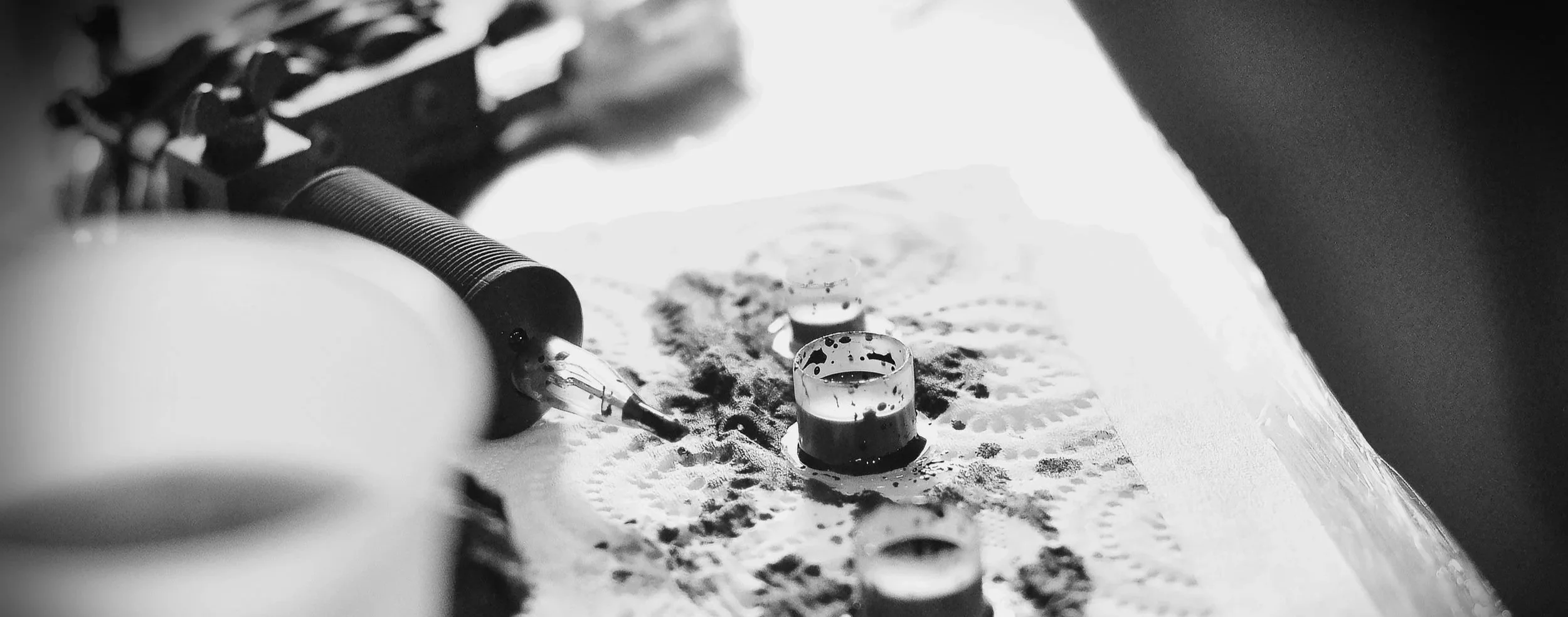
Those questions are valid. A tattoo is, after all, a controlled injury that requires the immune system to respond. But the relationship between tattooing and the body may be far older and more complex than modern discussions suggest.
Long before researchers studied antibodies and immune markers, cultures around the world used tattooing not only for identity, ritual, and status, but also with the belief that it could influence health and healing.
Much of what we now know about medicinal tattoo traditions comes from the work of tattoo anthropologist Lars Krutak, who has spent decades documenting tattoo practices across more than fifty Indigenous societies. Through his fieldwork, Krutak has explored how tattooing has served not only as cultural expression, but also as a practice connected to healing, protection, and the human relationship with the body.
In 2016, medical anthropologist Christopher Lynn and fellow anthropologist Michaela Howells, measured something unexpected in people getting tattooed: their immune systems. Using saliva samples collected before and after tattoo sessions, Lynn tracked immunoglobulin A (IgA), an antibody involved in the body’s first line of defense against infection, along with cortisol, the body’s primary stress hormone. His hypothesis was that repeated tattooing might condition the immune system in a way similar to how exercise conditions the body—by repeatedly exposing it to a controlled stressor and potentially creating a more efficient response over time.
This idea echoes a broader principle seen in medicine. Intravenous immunoglobulin therapy, or IVIG, uses pooled antibodies from healthy donors to help regulate harmful immune responses in certain autoimmune and inflammatory conditions, including some forms of nerve-related disease. IVIG does not work the same way tattooing might, but it demonstrates an important concept: the immune system can sometimes be guided or supported in ways that help the body manage damage and restore balance.
Lynn’s study found that experienced tattoo recipients showed different immune responses after tattooing compared with first-time recipients. The findings attracted attention, but they also received criticism. Science-Based Medicine argued that the results could reflect statistical limitations rather than a meaningful biological effect, and Scientific American cautioned against overstating the conclusions. The study was small, the participant group was limited, and the findings have not yet been replicated on a larger scale.
Rather than inspiring large, well-funded follow-up research to test Lynn’s hypothesis, the subject received little additional attention. But the more interesting question is not whether Lynn’s study stands alone, but rather it is the idea behind it that echoes something far older.
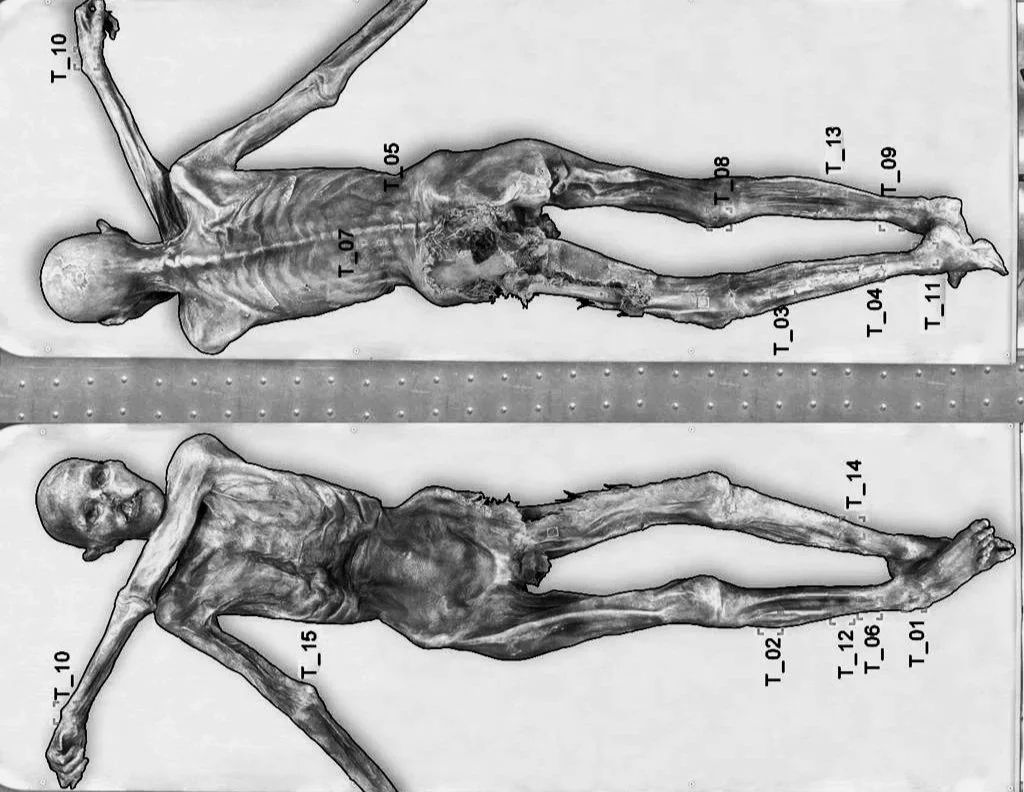
Otzi - map of areas utilized
Five thousand years earlier
In 1991, hikers discovered Ötzi, a man preserved in the Alps since roughly 3300 BCE. His body carried sixty-one tattoos—simple lines and crosses hidden beneath hair and clothing. When researchers compared the locations of his tattoos with traditional acupuncture points, many showed overlap, with some researchers estimating roughly 80 percent alignment depending on the mapping system used. The locations corresponded with areas associated with conditions Ötzi himself appeared to have, including joint degeneration and digestive problems caused by parasites. The timeline is striking. The earliest written records of acupuncture date to around 100 BCE. Ötzi’s tattoos existed more than two thousand years earlier.
Krutak became particularly interested in this connection between Ötzi’s tattoos and ancient therapeutic practices. Working with tattoo artist Colin Dale, he explored reconstructed bone-needle tattooing techniques similar to those used in ancient traditions. Their work examined whether tattoo placement and method could have produced effects consistent with historical accounts of therapeutic tattooing. While not a clinical study, these experiments offered a rare opportunity to examine how ancient tattoo practices may have functioned.
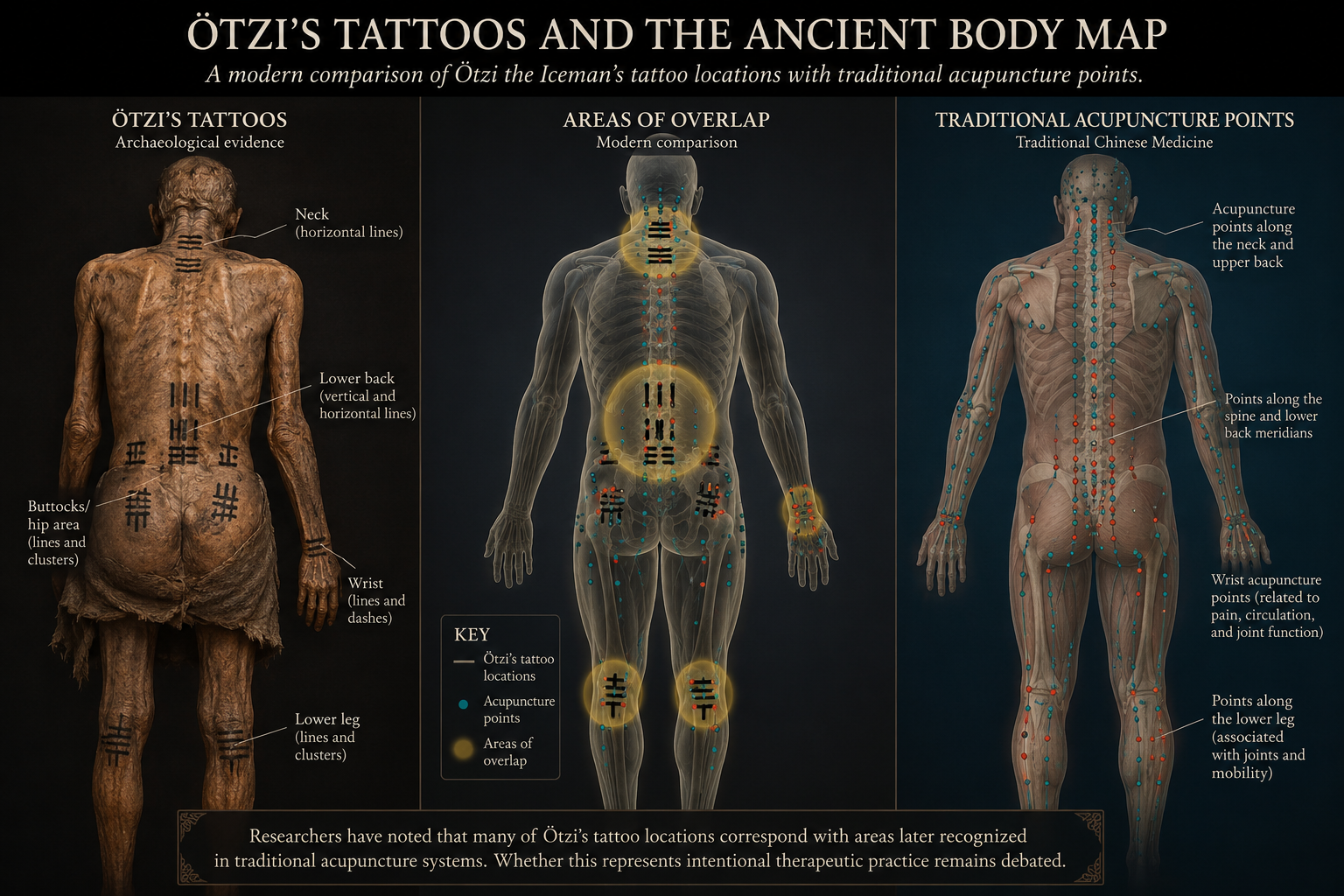
comparison of Otzi and traditional chinese acupuncture maps
The same idea, independently discovered
On St. Lawrence Island, Alaska, Yupiget tattooers developed similar practices, marking painful joints and other areas to address headaches, colic, and chronic pain. These traditions, documented through anthropological research including Krutak’s work, appear to have developed independently from Chinese medicine.
In Inuit communities, tattooing—known as kakiniit—also carried cultural meaning. Chin tattoos could mark a woman’s transition into adulthood, while hand tattoos could represent achievement, identity, and status. Yet alongside those meanings existed another belief: that tattooing could influence the body itself.
Why this keeps happening
A frozen mummy, living Arctic traditions, and a modern immune study are separated by thousands of years and continents, yet they point toward the same question: could tattooing affect the body in ways beyond decoration?
Lynn’s critics raised valid concerns about methodology, sample size, and replication—not proof that the question itself was wrong. To date, no large, well-powered study has definitively answered whether repeated tattooing creates lasting changes in immune function.

Tattooing carries real risks, including infection, allergic reactions, and inflammation. Yet across cultures and throughout history, humans have repeatedly returned to the same idea: that deliberately marking the body may do more than change its appearance. Whether that reflects biology, cultural intuition, or some combination of both remains an open scientific question—one that deserves a closer look and hopefully science agrees.
